The Africa Twin is finally running again! Over the past two years, I’ve broken down twice on my way home from Spain. The last time was because the engine wasn’t getting any fuel at high RPMs, under high heat, and in high temperatures.
The Honda XRV 750 RD07 is probably the perfect motorcycle, aside from one weak spot: the fuel pump. Fortunately, the previous owner (and dear friend) had the foresight 13 years ago to give the then 20-year-old motorcycle a new “heart” as a precaution. The best part: Instead of the unreliable electronics from the ’90s, the new pump operates entirely without electricity. A vacuum is created in the pump via a hose connected to the intake manifold (or another engine component). The vacuum moves a diaphragm, which in turn pumps the fuel. At 40 °C and high RPMs, the 13-year-old rubber diaphragm finally gave out last year.
But since I still want to ride in the heat, I needed a solution: an electric Facet fuel pump.
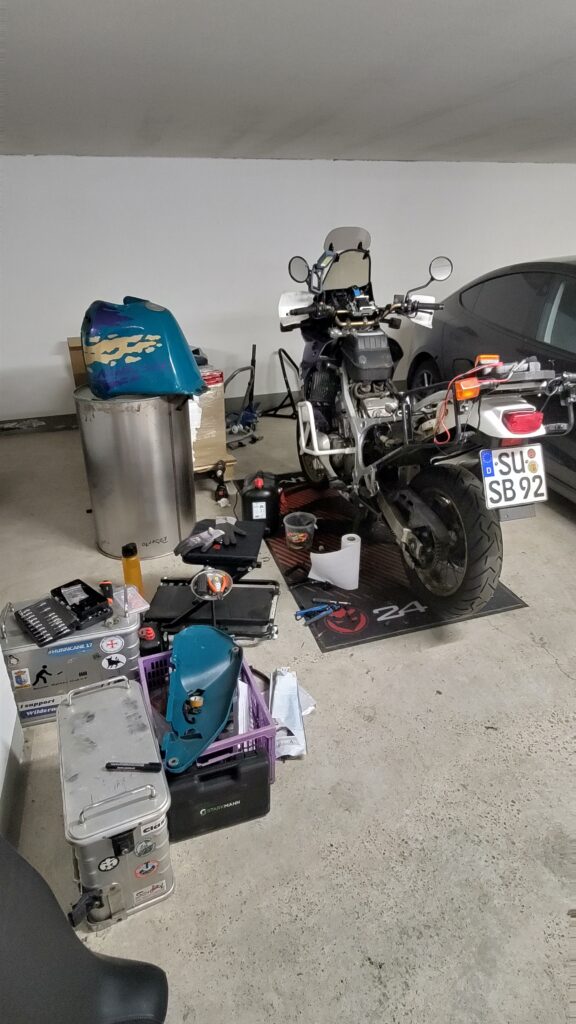
What could be better than working on a motorcycle in an underground garage when it’s over 30 °C? Nothing! At least as long as you don’t run into any problems.
Connect the pump, do a quick electrical test, wire and insulate everything properly, put (almost) everything back together, and then the big moment—does the engine run? Yes, but only for a few seconds until the carburetor’s float chambers run out of fuel.
What happened? The motorcycle is already old; something must have broken down somewhere over time. Why was a new pump installed in the first place? Was there perhaps a problem with the electrical system?
As a developer, you know the drill: First, take a rough look at the whole system; does anything immediately catch your eye? If not, dive into the individual parts. Examine all the components piece by piece—debug! In a world I’m familiar with, no problem. Here? “Imposter syndrome” might not be the correct term, but it describes the same feeling. Doubt. Are my basic assumptions even correct? Is my multimeter even measuring correctly? Does a motor really only need air, gasoline, and a spark, or did I imagine it to be too simple?
One way to learn as you get older is to put yourself in precisely these situations of doubt. It’s good practice for questioning the status quo, your own abilities, and general circumstances. Just as boredom forces children to become creative, think creatively, and discover completely new things about themselves and the world, “failure” is often a way for adults to apply new patterns and solutions.
In the end, it was an open air filter cover. If I had fully assembled the motorcycle and not expected a perfect result halfway through, everything would have worked.
And now? Now I understand my motorcycle’s wiring harness (better), have a better grasp of how an engine really works, know what a multimeter does, and have learned once again that good old Bug-Teddy (shout-out number 1, Marc Görtz) is the best way to understand a problem.
It would be nice if you could just learn new things without any challenges—like being able to download “how to be a helicopter pilot” in The Matrix. Of course, I could read books and watch YouTube videos. But in the end, being able to apply something, to see, feel, and taste the result—whatever it may be—is the best reward for me.
A shout-out here to Marc Görtz (shout-out number 2), who, on a hazy Tuesday night, pushed me to start writing a blog after all. So here it is!